Art and Culture Class 04
ELLORA CAVES (5:12 P.M.)
- It is located in Chattrapati Sambhajinagar.
- A total of 34 caves were developed in this place. The development of these caves started in the Gupta age.
- However, it reached its climax during the period of Rasthakutas.
- 17 caves belong to Hinduism, 12 to Buddhism, and 5 to Jainism.
- Inside the Buddhist caves, specimens related to Buddhism were created. For example, the sculpture of Buddha.
- Similarly in Jain caves, the sculptures of Tirtankars were created.
- Hinduism was a dominating religion in the Ellora.
- Cave premise no. 16 is known as Kailashnath temple.
-
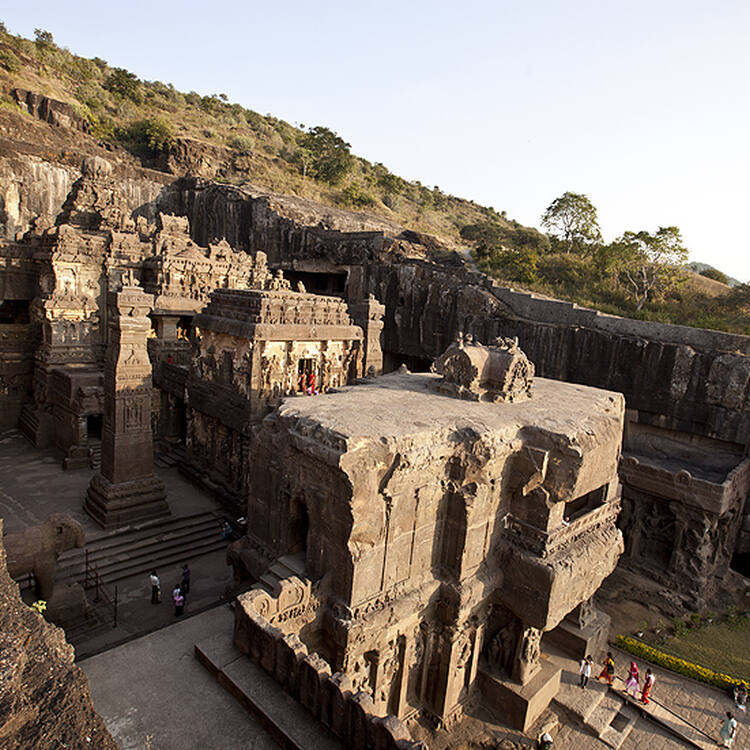
- It is a monolith created by Rashtrakuta king Krishna I.
- It is regarded as one of the architectural wonders.
- Inside the Hindu caves, some fresco mural paintings were also created.
- The best surviving example is the image of Lord Vishnu, riding on Garuda.
ELEPHANTA CAVES
- It is located off-coast Mumbai on an Island.
- At this place, a specimen related to Hinduism can be seen.
- It has images based on Shaivism and Vaishnavism.
- One of the most famous sculptures from this place is Trimurti.
-

- It includes the images of Uma, Mahesh, and Bhairava.
NASIK CAVES
- There are a total of 23 sandstone caves, which belong to the Hinayana phase of Buddhism.
- The development of these caves started in the post-Maurya age, and they reached their climax in the Gupta period.
- These caves are generally Viharas for the Buddhist monks.
-

- Note:
- Nasik is otherwise known for Hinduism.
- One of the four Kumbh melas is held at this place.
- Moreover, the Godavari River emerges from Trimbak Kund of Nasik.
- It is also an abode of one of the Shiv Jyotirlinga, i.e. Trimbakeshwar.
12 SHIV JYOTIRLINGA
- Somnath and Nageshwar are in Gujarat.
- Girishneshwar, Trimbakeshwar, and Bhimashankar in Maharashtra.
- Rameshwaram in Tamil Nadu.
- Mallikarjuna-Srisailam in Andhra Pradesh.
- Mahakaleshwar and Omkareshwar in Madhya Pradesh.
- Vaidyanath (Deoghar) in Jharkhand.
- Kashi Vishwanath in Uttar Pradesh.
- Kedarnath in Uttarakhand.
BAGH CAVES (5:44 P.M.)
- These are situated on the banks of River Bagh, near Indore.
-

- A total of 9 sandstone caves were created at this place. All of them belong to Buddhism.
- Cave number 4 is popularly known as Rangmahal. It has beautiful frescos based on Buddhism.
JUNAGADH CAVES
- These are situated in the Girnar hills of the Gujarat.
- These caves are also referred to as Uparkot. It means that cave chambers are created on the upraised platforms connected through stairs from the base.
- This cave was associated with Buddhism. However, some Hindu motifs have also been found in these caves.
EVOLUTION OF TEMPLE IN NORTH (5:49 P.M.)
- The Nagara style of temples developed in three phases during the Gupta age, which is as follows,
- (a) First Stage
- In this phase, the flat-roofed square temples were created on the grounded platform.
- It also included shallow pillars meant for decoration.
- For example, Temple No. 17 of Sanchi.
- (b) Second Stage
- In this phase, temples were created on upraised platforms called Jagati.
- They continued the flat-roofed square temple approach. However, in this phase, in-depth pillars were used.
- These were also a few instances of a double-storied flat-rood temple.
- For example, the Parbati Temple of Nachna-Kuthara temple in Madhya Pradesh.
- (c) Third Stage
- In this stage, a curvy linear tower was introduced on the top of the chamber. This was popularly known as Shikhar.
- This stage is said to be a precursor of the Nagara style of temple.
- For example, the Bhitargaon temple of Kanpur and the Dashavatar Temple of Deogarh (Jhansi).
NAGARA STYLE OF TEMPLE (6:03 P.M.)
- Nagara is an umbrella style of temple in northern India.
- Its origin can be traced to the Gupta cities.
-

- It had the following features:
- (a) The characteristic feature of the Nagara-style temple is the presence of a curvilinear tower, Shikara.
- (b) Generally the boundary walls are not created in the Nagara temples.
- (c) The upraised platform on which the temple is created is known as Jagati.
- (d) Madap is the prayer hall of the temple, and also it comprises a large number of in-depth pillars.
- (e) The main chamber of the temple is called Garbhgriha.
- In it, the idols of deities are placed.
- It is regarded as the place of new birth.
- (f) The tower on the top of Garbhagriha is often equated with the mythological mountains Kailash and Meru.
- (g) Generally, Nagara temples include a covered ambulatory passageway called Parikramapath.
- (h) Amalak is the horizontal disc that gives a pause to the rising layer of the tower.
- (i) The top-most structure is the finial which differs from place to place. For example, Kalash, Trishul, Flag, etc.
- (j) Generally Nagara temples were created in the crucified ground plan.
- (k) Generally, in Nagara temples, the water tanks were not created.
- For example, Kashi Vishwanath Temple, Omkareshwar Temple, Mahakaleshwar Temple, etc.
SUB-STYLES OF NAGARA TEMPLE (6:31 P.M.)
- Odisha Style
- It started to develop under the patronage of the Ganga dynasty and the Gajapati dynasty.
- Features of Odisha Style Temples
- (a) The boundary wall can be seen in Odisha temple.
- (b) The exterior walls of Odisha temple were lavishly decorated with intricate carvings.
- (c) However, the interior walls are kept entirely plain.
- (d) The characteristic feature of Odisha temple is the presence of Deula Shikhar.
- It is almost vertical for a greater length and only near the top curvature is created.
- The hall in the Odisha style is called Jagmohan.
- Some of the temples in Odisha style are known for Tantrik practices. This is reflected in the sexual images on the walls of the temple.
- Some of the temples have installed wooden images of the god inside the temple.
- For example, Jagannath Temple (Puri), Lingaraj Temple (Bhubneshwar), Konark Temple (Konark), Raja Rani Temple (Bhubneshwar), etc.
- Khajuraho Style (7:07 P.M.)
- It was developed by the Chandela rulers of Bundelkhand.
-

- Features
- (a) These temples are considered the climax of the Nagara style of temples.
- (b) They are created on a relatively very high platform.
- (c) It is noted for the presence of multiple chambers and multiple shikars of varying sizes.
- These Shikhars give an impression of the mountain range.
- (d) The chambers of the temple were interconnected with each other in the east-west direction.
- (e) On the walls of the temple, a few erotic and sexual images were also created.
- For example, Kandariya Mahadeo Temple (Khajuraho) and Lakshmana Temple (Khajuraho).
- Not only Hindu but jain temples were also created in this style.
- For example, Parsvanath Temple and Ghantai Temple.
- In some of the areas of Bundelkhand, circular temples were also created.
- They were mainly patronized by the Kacchapaghata dynasty.
- These circular temples are present in many places like Morena, Jabalpur, and Khajuraho.
- It is said that the Chausath Yogini Temple of Morena was an inspiration behind the design of the old Parliament building.
-

- Solanki Style of Temple (7:26 P.M.)
- It was developed by the Solanki rulers of Gujarat.
- It was practised in the area of south Rajasthan and entire Gujarat.
- Features of Solanki Style of Temple
- (a) The exterior walls of the temple were optimally decorated.
- (b) The interior walls were lavishly decorated.
- (c) This style of temple architecture is noted for the finest stone tracery works (Jali work).
- (d) Beautiful Hindu motifs and geometrical designs were created in this style.
- (e) The temples are generally built facing the east direction so that on the day of the equinox, sun rays fall directly in the Garbgriha chamber.
- (f) In some of the temples, step water tanks were created. Moreover, on the majority of the stairs, a small replica of the temple was also created.
- Not only Hindu but also a large number of Jain temples were created in this style.
- For example, Sun Temple (Modhera), Somnath Temple, Ambaji Temple, etc are Hindu temples.
- Bhadreshwar Jain Temple, Ranakpur Jain Temple, and Dilwara Jain Temple are notable Jain temples built using this style.
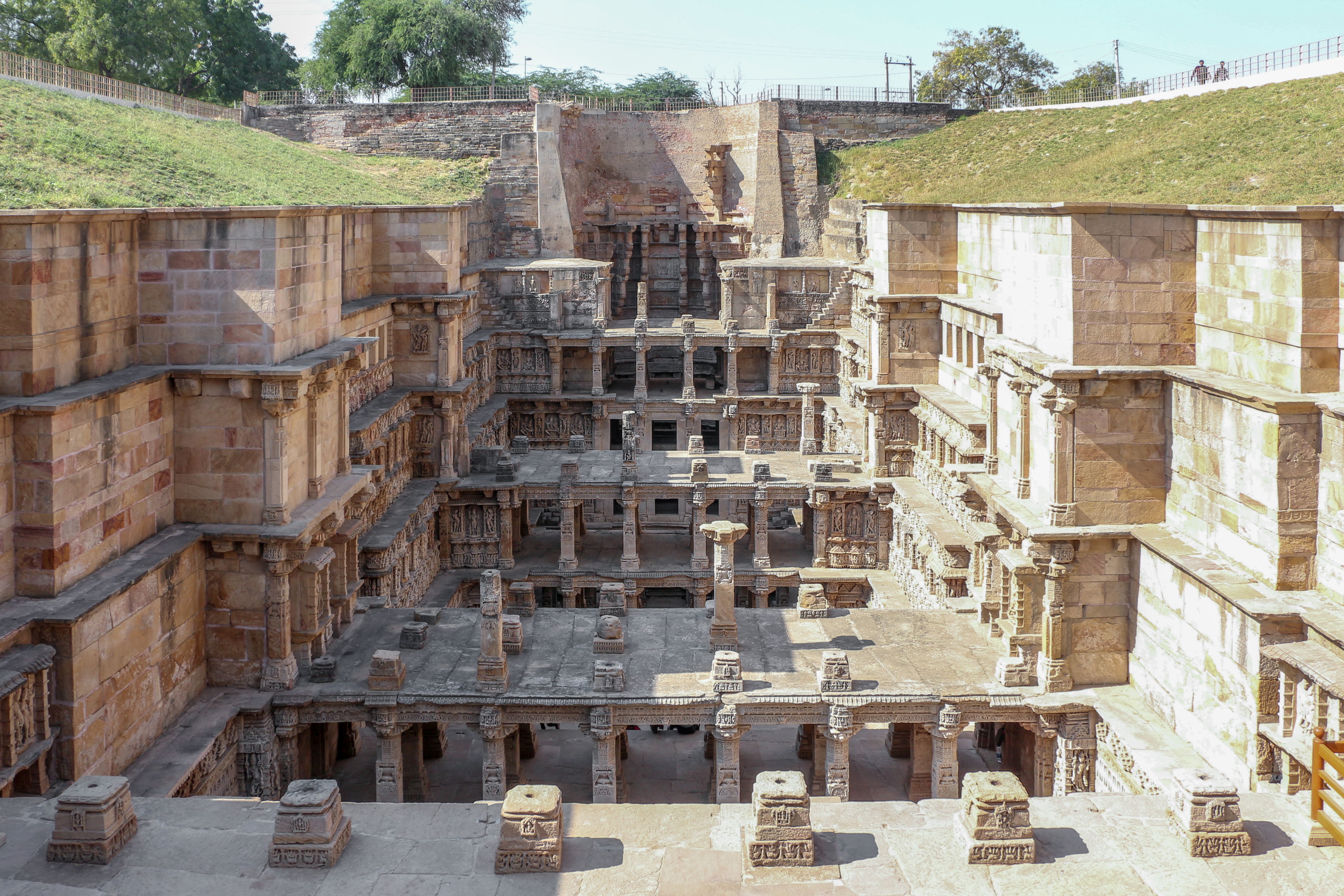
- Not only temples but also step wells with elaborate sculptures based on Hindu mythology were created.
- The best example is Rani ki Vav of Patan, which is a UNESCO heritage site.
-
THE TOPIC FOR THE NEXT CLASS: SOUTH INDIAN TEMPLE ARCHITECTURE